

- The Cost of the Wrong Tool at Enterprise Scale
- What “Scalable” Actually Means in Enterprise PM
- Red Flags: When Your Current PM Tool Is Holding You Back
- Enterprise Use Cases: How Large Organizations Use PM Software Differently
- The Enterprise Buyer’s Evaluation Checklist
- Top Project Management Tools: An Honest Comparison
- Implementation: What Enterprise PM Rollout Actually Looks Like
- ROI of Enterprise Project Management Software
- Conclusion: Choosing a Tool Your Enterprise Won’t Outgrow
- Frequently Asked Questions
01 THE COST OF THE WRONG TOOL AT ENTERPRISE SCALE
Most project management tools don’t fail overnight. They fail gradually, as organizations outgrow them and begin to hit the limits of project scalability.
What works for a 20-person team quickly starts breaking down when you’re managing hundreds of projects across departments, regions, and budgets. The cracks show up first in small ways: teams duplicating data in spreadsheets, project timelines slipping because dependencies aren’t visible, and leadership asking for reports that take days to compile. Over time, these inefficiencies compound into something far more serious — operational drag that directly impacts scalable project delivery.
For mid-to-large enterprises, the cost of using the wrong tool isn’t just missed deadlines. It’s misallocated resources across business units, poor visibility into project profitability, and delayed decision-making at the executive level.
When finance operates in one system, resource planning in another, and project tracking in a third, alignment becomes a constant struggle. This is where the lack of true scalability in project management becomes visible — not in features, but in outcomes.
What makes this particularly risky is that many organizations continue using tools that are “good enough for now.” They scale usage, add more users, and build workarounds — without addressing whether the system itself can support scalable project tracking across growing portfolios. The result is a patchwork of processes that becomes harder to maintain with every new project, team, or dependency added.
At a certain point, the tool stops supporting the business and starts limiting it.
This is why understanding scalable project management software is critical — not as a feature checklist, but as an operational foundation. Before evaluating vendors, enterprise buyers need to clearly define what scalability actually means in their environment and how it impacts execution, visibility, and long-term growth.
02 WHAT “SCALABLE” ACTUALLY MEANS IN ENTERPRISE PROJECT MANAGEMENT
Scalability in project management is often misunderstood. Many vendors reduce it to a simple metric: how many users a system can support. But for enterprise environments, scalability is not about headcount — it’s about operational complexity.
A platform may handle thousands of users and still fail when asked to manage cross-functional dependencies, financial oversight, or multi-project coordination. This is the reality many PMOs and IT leaders face today. Systems that once worked at a team level begin to break when applied across business units, leading to fragmented reporting, inconsistent processes, and growing reliance on manual workarounds. True scalable project management software must support how work expands, not just how teams grow.
At the enterprise level, scalability operates across five distinct dimensions.
First is portfolio-level visibility. PMOs and executives need a unified view across all initiatives, not isolated project dashboards. Without this, CXOs are forced to make strategic decisions based on incomplete or outdated data. This often results in overcommitted portfolios, delayed initiatives, and missed business objectives.
Second is resource management across departments and geographies. For IT leaders and operations heads, one of the biggest challenges is understanding who is working on what, and whether capacity actually exists. In most organizations, this visibility is fragmented or manually maintained, leading to resource conflicts, burnout, and underutilized teams at the same time.
Third is financial tracking at both project and portfolio levels. CFOs and business leaders increasingly demand real-time insight into project costs, forecasts, and ROI. Yet in many enterprises, financial data still lives outside the project management system. This disconnect delays decisions, hides cost overruns, and makes it difficult to assess true project performance.
Fourth is integration depth. Enterprise IT environments are inherently complex, spanning ERP, CRM, HRMS, and analytics platforms. IT managers often struggle with tools that claim integration but rely on fragile connectors or custom development. The result is data silos that undermine trust in the system and force teams back into spreadsheets.
Finally, there is deployment flexibility. For government agencies, BFSI organizations, and research institutions, compliance, security, and data residency are non-negotiable. Cloud-only tools create barriers in these environments, while rigid on-premise systems limit agility. A scalable solution must support both without compromising capability.
These challenges are not theoretical — they reflect how modern enterprises operate. As organizations scale, so do their expectations from project systems: faster reporting for CEOs, clearer visibility for PMOs, tighter financial control for leadership, and seamless execution for delivery teams.
This is where the distinction becomes clear: some tools scale in price, while others scale in capability.
The former add users and cost as you grow but rely on the same underlying limitations. The latter are designed for scalable project planning and execution, where complexity, data volume, and organizational structure can expand without breaking the system.
Understanding this difference is what separates a short-term tool choice from a long-term platform decision.
Struggling with Resource Overload & Project Delays?
See how enterprises gain real-time visibility into capacity, timelines, and financials — without spreadsheets or disconnected tools.
Book a Demo →03 RED FLAGS: WHEN YOUR CURRENT PM TOOL IS HOLDING YOU BACK
Most enterprise teams don’t actively decide to outgrow their project management tool. They realize it too late — when inefficiencies have already become embedded in daily operations.
The first red flag is the absence of a true portfolio-level view. If leadership still relies on slide decks, spreadsheets, or manual consolidation to understand project status, the system is already falling short. At scale, this creates a lag between reality and reporting — and decisions are only as good as the data behind them.
Another clear signal is resource planning happening outside the system. When project managers maintain separate spreadsheets to track capacity, availability, or workload distribution, it indicates the tool cannot support scalable project tracking across teams. This often leads to a familiar pattern: some teams are overloaded while others remain underutilized, and no one has a reliable view of the imbalance.
A more serious limitation appears when financial tracking is disconnected from execution. If budgets, forecasts, and actual costs live in separate systems, organizations lose the ability to measure real-time project performance. For CFOs and PMOs, this creates blind spots around profitability, cost overruns, and ROI — all of which are critical at enterprise scale.
Customization is another friction point. Many tools appear flexible on the surface but require extensive developer effort or third-party workarounds to adapt workflows across departments. For IT teams, this becomes a long-term maintenance burden. For business users, it slows down adoption and creates inconsistent processes across the organization.
There’s also a structural issue that often goes unnoticed: the tool works well for one team but breaks across business units. Marketing may use it one way, engineering another, and operations not at all. Without a unified system, organizations end up with fragmented execution — the exact opposite of what scalable project management software is supposed to enable.
Finally, onboarding new teams becomes increasingly difficult. Instead of scaling smoothly, the system introduces friction — more training, more customization, more exceptions.
Individually, these issues may seem manageable. Together, they signal a deeper problem: the platform has reached its scalability limit.
And the longer an organization continues to operate this way, the higher the hidden cost — in lost productivity, slower decision-making, and reduced confidence at the leadership level.
04 ENTERPRISE USE CASES: HOW LARGE ORGANIZATIONS USE PM SOFTWARE DIFFERENTLY
At enterprise scale, project management is no longer about tracking tasks. It becomes a system of control, coordination, and financial governance across multiple moving parts. Different industries push project management software in very different ways, and that’s where most tools begin to show their limits.
Across all these industries, one pattern is clear. The need for scalable project management software is not driven by team size alone, but by operational complexity, financial accountability, and cross-functional coordination.
This is where many organizations begin to question whether their current tools are still the right fit.
05 THE ENTERPRISE BUYER’S EVALUATION CHECKLIST
By the time an organization starts evaluating scalable project management software, the stakes are already high. This isn’t about testing a new productivity app. It’s about choosing a system that will sit at the center of execution, financial visibility, and decision-making across the enterprise.
Yet many buying processes still focus on surface-level features instead of operational fit. The result is predictable: tools that look powerful in demos but struggle under real-world enterprise complexity.
A more effective approach is to treat evaluation as a structured interrogation. Not “what can this tool do?” but “can this tool handle how we operate at scale?”
Here’s the checklist enterprise buyers should use when evaluating any platform:
Can leadership see how all projects connect to strategic objectives, or is reporting limited to individual project views stitched together manually?
For PMOs and operations leaders, visibility into utilization is non-negotiable. If teams are still balancing workloads in spreadsheets, the system isn’t solving the core problem.
CFOs and finance teams increasingly expect real-time visibility into budgets, forecasts, and actuals. If cost tracking lives outside the platform, decision-making will always lag behind execution.
Enterprise environments rely on ERP, CRM, HRMS, and BI systems. The question isn’t whether integrations exist, but whether they are stable, real-time, and maintainable without constant IT intervention.
Government agencies, defense organizations, and regulated industries often require on-premise or hybrid deployment. A cloud-only tool can become a blocker before implementation even begins.
Enterprise rollout is not self-serve. Vendors should provide structured implementation support, data migration assistance, and a clear roadmap for adoption across business units.
IT leaders and compliance teams need granular control over who sees what. One-size-fits-all permission models rarely survive enterprise governance requirements.
Some tools appear affordable initially but become cost-prohibitive as user count, data volume, and feature requirements grow. Buyers need clarity on long-term cost structure, not just entry pricing.
Case studies, customer segments, and retention rates matter. A platform used primarily by small teams may not withstand enterprise-scale complexity, regardless of feature lists.
When evaluated through this lens, the differences between tools become clearer. Some platforms are optimized for team productivity. Others are built for organizational control, visibility, and scale.
That distinction is where most buying decisions are either validated or quietly deraile
Struggling with Resource Overload & Project Delays?
See how enterprises gain real-time visibility into capacity, timelines, and financials — without spreadsheets or disconnected tools.
Book a Demo →06 TOP PROJECT MANAGEMENT TOOLS FOR ENTERPRISES: AN HONEST COMPARISON
Enterprise buyers rarely evaluate a single tool in isolation. By the time you reach this stage, you’re already comparing multiple platforms across functionality, scalability, and long-term fit.
The challenge is that most tools appear similar at a surface level. They all offer dashboards, task tracking, and reporting. The real differences only become visible when you evaluate how they perform under enterprise-scale complexity.
Here’s a structured comparison across key dimensions that actually matter:
| Tool | Portfolio Management | Resource Management | Financial Tracking | On-Premise Option | Enterprise Support | Best Fit Organization Size |
|---|---|---|---|---|---|---|
| Celoxis | Strong, real-time portfolio dashboards with cross-project visibility | Advanced capacity planning across teams | Built-in budgeting, forecasting, and cost tracking | Yes (Cloud + On-Premise) | Dedicated onboarding & enterprise support | Mid-to-large enterprises |
| Microsoft Project / Project Online | Strong within Microsoft ecosystem | Moderate, requires configuration | Limited natively, often integrated with other tools | Yes | Strong enterprise presence | Large enterprises already using Microsoft stack |
| Smartsheet | Good for reporting, but limited depth at scale | Basic resource visibility | Limited, requires add-ons | No | Moderate | Mid-sized teams scaling operations |
| Planview | Enterprise-grade portfolio and strategic planning | Advanced | Strong financial and scenario planning | Limited (primarily cloud) | High-touch enterprise support | Large enterprises & PMOs |
| monday.com (Enterprise) | Visual dashboards, limited portfolio depth | Basic to moderate | Limited financial tracking | No | Moderate | Growing teams, not deeply complex environments |
| Wrike | Good cross-project visibility | Moderate | Basic financial features | No | Moderate | Cross-functional enterprise teams (non-production) |
What stands out in this comparison is not just feature availability, but depth and integration.
Tools like monday.com and Smartsheet scale well for visibility and collaboration but begin to show limitations when financial tracking or cross-portfolio governance becomes critical. They are often adopted by business units but struggle to unify the entire organization.
Microsoft Project remains a strong option for enterprises deeply embedded in the Microsoft ecosystem, though it often requires additional tools or integrations to achieve full portfolio and financial visibility.
Planview operates at the higher end of the enterprise spectrum, offering deep portfolio and financial capabilities, but typically comes with higher complexity and implementation overhead.
What separates purpose-built enterprise platforms from scaled-up team tools is their ability to connect portfolio management, resource planning, and financial tracking in a single system. Without that integration, organizations are forced into patchwork solutions that reintroduce silos — the very problem they set out to solve.
This is where the conversation naturally shifts from comparison to fit. Not which tool has more features, but which one aligns with how your organization actually operates at scale.
6.1. CELOXIS: BUILT TO SCALE WITH YOUR ENTERPRISE
For organizations evaluating scalable project management software, the gap between what tools promise and what they actually deliver becomes obvious only after implementation. Many platforms handle visibility well, some handle collaboration, and a few address resource planning. Very few bring all three together with financial control at the core.
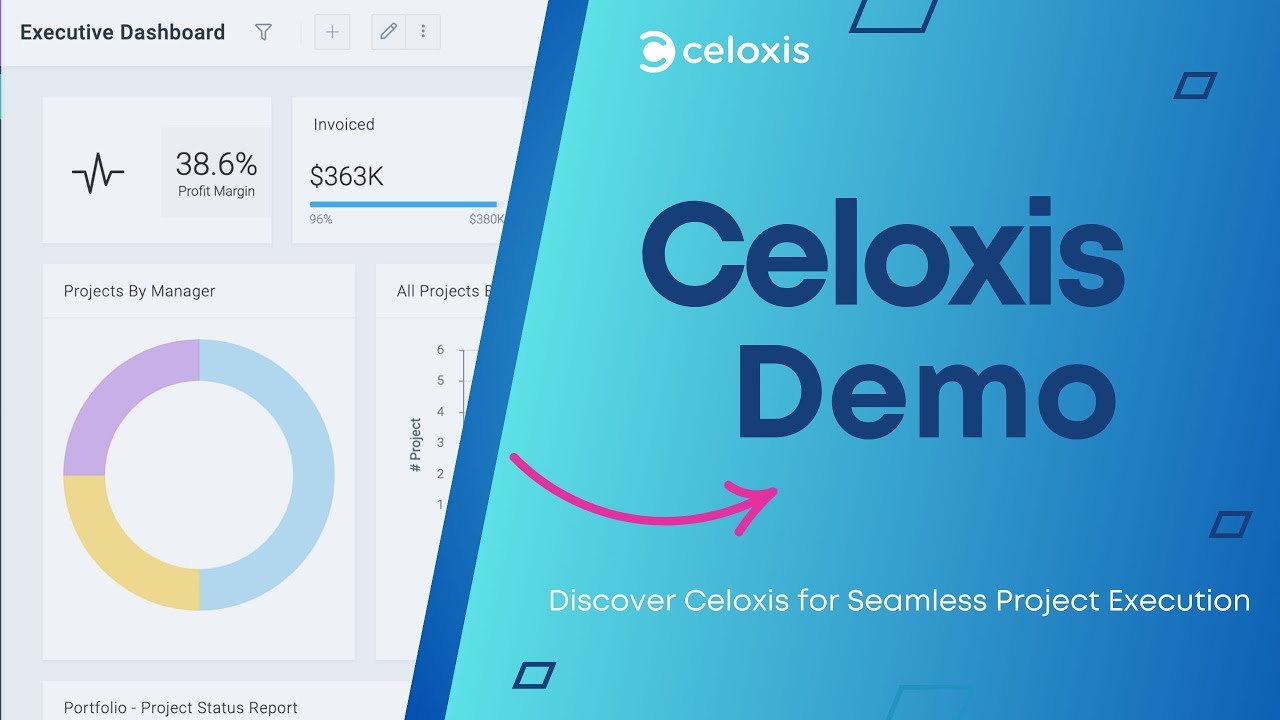
This is where Celoxis enterprise project management stands apart. It is designed specifically for mid-to-large organizations that need to manage not just projects, but entire portfolios with interdependencies, shared resources, and budget accountability. Instead of stitching together multiple tools, Celoxis connects project scheduling, resource capacity planning, and financial tracking in one unified system. That means PMOs, IT leaders, and operations heads get a single source of truth across all active initiatives.
A key advantage for enterprises is architectural flexibility. Celoxis supports both cloud and on-premise deployment, which is critical for government agencies, defense organizations, and regulated industries where data control is non-negotiable. At the same time, its performance is built to handle high volumes of concurrent projects, users, and data, without slowing down reporting or decision-making.
Beyond features, what matters at enterprise scale is execution. Celoxis brings over two decades of experience working with Fortune 500 companies, engineering firms, public sector organizations, and global teams. That shows up in how the platform handles real-world complexity, from multi-department workflows to portfolio-level financial governance. Dedicated onboarding and implementation support further ensure that organizations don’t just adopt the tool, but actually operationalize it.
This also becomes particularly relevant in the current market context. With tools like Microsoft Project moving toward retirement timelines, many enterprises are reassessing their long-term PM technology stack. Solutions that rely heavily on ecosystem dependencies or fragmented integrations are being re-evaluated in favor of platforms that offer depth, flexibility, and long-term scalability in a single system.
For enterprises that have outgrown task-based tools but want to avoid the overhead of full ERP implementations, Celoxis for large organizations fits into a very specific and often underserved space. It delivers the control, visibility, and financial insight required to run complex project environments without introducing unnecessary system complexity.
In practice, this means fewer silos, faster decision-making, and a PMO that operates with real authority rather than reactive reporting.
You May Also Check:
Ready to See Celoxis in Action?
Explore how enterprise organizations manage complex portfolios, resources, and financials — all in one unified platform.
6.2. MICROSOFT PROJECT: STRUCTURED PLANNING WITH EVOLVING LIMITATIONS
Microsoft Project has historically been a go-to choice for enterprises needing structured scheduling and planning. Its strength lies in detailed Gantt charts, dependency management, and tight integration with the broader Microsoft ecosystem, including Teams, Excel, and SharePoint. For organizations running traditional, waterfall-driven programs, it still provides a familiar and controlled environment.
However, at enterprise scale, its limitations are increasingly difficult to ignore. Portfolio visibility often requires stitching together multiple Microsoft tools, and financial tracking is not deeply embedded within the platform. Collaboration also depends heavily on external integrations rather than being natively unified.
Portfolio visibility often requires stitching together multiple Microsoft tools, and financial tracking is not deeply embedded within the platform.
This becomes more relevant as Microsoft gradually transitions away from older Project models, with retirement timelines influencing long-term planning decisions. Enterprises evaluating scalable project management software today are starting to look beyond Microsoft Project toward platforms that offer deeper portfolio, financial, and resource integration in a single system.
You May Also Check:6.3. SMARTSHEET: FLEXIBLE AND FAMILIAR, BUT LIMITED IN DEPTH
Smartsheet appeals to enterprises because of its spreadsheet-like interface, which makes adoption across teams relatively frictionless. It works well for organizations that need a flexible system to manage workflows, track progress, and create data-rich dashboards without extensive training.
That said, scalability here is more about usability than operational depth. While Smartsheet can handle large teams and multiple projects, it often relies on add-ons and integrations to support advanced resource planning, governance, and financial tracking. Over time, this can lead to fragmented workflows and increased system complexity.
While Smartsheet can handle large teams and multiple projects, it often relies on add-ons and integrations to support advanced resource planning, governance, and financial tracking.
For enterprises managing high-stakes portfolios with budget accountability and cross-department dependencies, Smartsheet is often used as a coordination layer rather than a complete portfolio management system.
You May Also Check:6.4. PLANVIEW: POWERFUL PORTFOLIO GOVERNANCE, COMPLEX EXECUTION
Planview is built for enterprise PMOs that prioritize strategic alignment, portfolio planning, and investment governance. It excels in demand management, scenario modeling, and aligning projects with business objectives at a high level.
Where it can become challenging is in execution and usability. Implementation cycles tend to be longer, and the platform can feel heavy for teams outside the PMO. Customization and configuration require careful planning, which may slow down adoption across departments.
Implementation cycles tend to be longer, and the platform can feel heavy for teams outside the PMO.
Planview is best suited for organizations that value top-down portfolio control and are willing to invest in a more complex system to achieve it.
Want to Improve Project ROI by 20%+?
Discover how centralized planning, financial tracking, and resource optimization drive measurable business outcomes.
6.5. MONDAY.COM (ENTERPRISE): HIGH ADOPTION, LIMITED PORTFOLIO CONTROL
monday.com has gained strong traction in enterprises due to its intuitive interface and flexibility. It allows teams to quickly build workflows, manage tasks, and collaborate across departments without steep learning curves.
However, its enterprise scalability is more surface-level. While it supports large teams and multiple use cases, it lacks native depth in financial tracking, advanced resource capacity planning, and portfolio-level analytics. Organizations often rely on integrations or external systems to fill these gaps.
It lacks native depth in financial tracking, advanced resource capacity planning, and portfolio-level analytics.
As a result, monday.com works well as a work management and collaboration platform, but less so as a centralized system for managing complex, cost-driven project portfolios.
You May Also Check:6.6. WRIKE: STRONG EXECUTION AND COLLABORATION, BUT NOT FULL PPM
Wrike offers a structured approach to project execution, combining task management, resource planning, and collaboration in a single platform. It is particularly effective for cross-functional teams managing operational or strategic initiatives that require visibility and coordination.
At enterprise scale, however, its limitations appear in financial governance and portfolio-level control. While it provides reporting and resource insights, it does not offer deeply integrated budget tracking or financial forecasting capabilities.
It does not offer deeply integrated budget tracking or financial forecasting capabilities.
For many organizations, Wrike serves as a strong execution layer, but it often needs to be complemented by additional systems to achieve full portfolio visibility and financial oversight.
You May Also Check:07 IMPLEMENTATION: WHAT ENTERPRISE PM SOFTWARE ROLLOUT ACTUALLY LOOKS LIKE
Choosing scalable project management software is only half the decision. The real test begins after the contract is signed, when the platform has to be implemented across teams, systems, and workflows that are already in motion.
Unlike SMB deployments, enterprise rollouts are not plug-and-play. They involve multiple stakeholders, legacy systems, compliance requirements, and operational dependencies. A rushed or poorly structured implementation can delay adoption by months, even if the tool itself is capable.
Most successful enterprise implementations follow a structured, phased approach.
The process typically begins with discovery and alignment. This is where PMOs, IT leaders, and business stakeholders define what success actually looks like. Which portfolios need to be migrated first? What level of financial tracking is required? How will resource data be structured across departments? Without this clarity, even the best platform will mirror existing inefficiencies.
The next phase is configuration and system design. Enterprise tools are rarely used “out of the box.” Workflows, approval hierarchies, dashboards, and access controls need to be tailored to match how the organization actually operates. This is also where integrations with ERP, CRM, HRMS, and BI tools are planned and tested.
From there, organizations move into data migration and pilot rollout. Historical project data, resource structures, and financial records are imported into the system. A controlled pilot, often within a single department or portfolio, helps validate workflows before scaling further. This step is critical. It exposes gaps early, before they impact the entire organization.
Once validated, the rollout expands through a phased deployment model. Instead of onboarding all teams at once, enterprises typically roll out the platform in stages, ensuring adoption, training, and system stability at each level. This reduces resistance and allows internal champions to emerge within teams.
Training is not a one-time activity here. Continuous enablement and change management play a major role in adoption. Even the most powerful system fails if teams fall back to spreadsheets or legacy tools out of habit.
- Will there be a dedicated implementation manager, or is support ticket-based?
- What does data migration support actually include?
- Are integrations handled natively or through third-party connectors?
- How long does a typical enterprise rollout take for organizations of similar size?
Vendors that promise “instant setup” for complex environments often underestimate the effort required. Lack of structured onboarding, limited migration support, or generic training programs usually leads to poor adoption later.
- Percentage of active projects migrated into the system
- Reduction in parallel tools or spreadsheets
- Adoption across departments, not just one team
- Visibility into real-time portfolio and financial data
At scale, implementation is not just a technical exercise. It is an operational shift. The goal is not to install software, but to establish a system that becomes the single source of truth for how projects are planned, executed, and governed across the organization.
08 ROI OF ENTERPRISE PROJECT MANAGEMENT SOFTWARE
At the enterprise level, investing in scalable project management software is rarely about features. It’s about measurable business impact. CFOs, CIOs, and PMO leaders are not asking, “Does this tool work?” They’re asking, “What changes financially and operationally after we implement it?”
The ROI comes from multiple layers. Some are immediately visible. Others compound over time.
1. Direct, Quantifiable ROI Levers
These are the gains leadership teams can track within the first 3–6 months:
Improved resource utilization
When capacity planning is centralized, organizations reduce both underutilization and burnout. Teams are assigned based on availability and skill, not guesswork.
Reduction in project overruns
Real-time visibility into timelines and dependencies allows teams to identify risks early instead of reacting late.
Faster reporting cycles
Executive dashboards replace manual status reports, freeing up PMO bandwidth and improving decision speed.
Consolidation of tools and systems
Many enterprises reduce 2–4 overlapping tools (spreadsheets, reporting tools, task managers), lowering both licensing costs and operational complexity.
More accurate financial forecasting
With budgets, actuals, and forecasts in one system, finance teams gain tighter control over project-level and portfolio-level spend.
2. Operational ROI That Compounds Over Time
- Cross-department alignment
- Stronger PMO credibility
- Improved audit readiness and compliance
- Better prioritization of strategic initiatives
These benefits are less immediate but far more strategic:
3. A Simple Enterprise ROI Model
Annual Impact Estimate:
Resource efficiency gains → +15% productivity across teams
Reduced overruns → 20% fewer delayed or over-budget projects
Reporting efficiency → hundreds of PM hours saved annually
Tool consolidation → reduction in software and maintenance costs
Even conservative estimates often justify the investment within the first year.
4. Metrics to Track Post-Implementation (First 6 Months)
- % improvement in resource utilization rates
- Reduction in project delays and budget overruns
- Time spent on manual reporting vs. automated dashboards
- Number of tools replaced or consolidated
- Adoption rate across departments (not just PMO)
At scale, the value of project management software is not just in execution. It’s in visibility, control, and the ability to make faster, better decisions across the entire organization.
And that’s where the real ROI shows up.
09 CONCLUSION: CHOOSING A TOOL YOUR ENTERPRISE WON’T OUTGROW
At enterprise scale, choosing project management software is not a short-term decision. It’s an architectural one.
What works for a team of 20 will not hold up for an organization managing hundreds of concurrent projects, multiple departments, and millions in budget allocation. The real risk is not choosing the wrong tool today, but choosing a tool that cannot evolve with your operational complexity over the next 3–5 years.
You May Also Check:- Buyer Guide to Project Management Software in 2026
- Choosing the Right Project Management Tool for Your Organization’s Size & Maturity
Scalability is often misunderstood as the ability to add more users. In reality, it’s about whether your system can handle growing portfolios, increasing financial complexity, cross-functional dependencies, and leadership-level reporting without breaking down or requiring constant workarounds.
Enterprise buyers who get this right don’t just look at features. They evaluate how well a platform aligns with their future state:
- Will it support portfolio-level decision-making as we scale?
- Can it unify resource, financial, and project data in one place?
- Will it reduce operational friction or introduce new layers of complexity?
The answers to these questions define whether your PM software becomes a long-term asset or a recurring problem.
If you’re currently evaluating enterprise project management software or rethinking your existing stack, the next step is simple: assess your needs against real-world scalability, not surface-level features.
And if your organization is at the stage where portfolio visibility, resource optimization, and financial control are becoming non-negotiable, it’s worth exploring a platform that’s built for that reality from the ground up.
10 FREQUENTLY ASKED QUESTIONS (FAQ)
What is scalable project management software? +
Scalable project management software is a system designed to handle increasing complexity across projects, teams, and data without performance loss or workflow fragmentation. It supports portfolio-level visibility, resource planning, and financial tracking across multiple departments.
How is enterprise project management software different from standard PM tools? +
Standard tools focus on task execution and team collaboration. Enterprise project management software adds layers like portfolio governance, financial control, resource optimization, and integration with ERP and BI systems.
When should an organization upgrade to scalable PM software? +
- Managing multiple concurrent projects across departments
- Lack of visibility into resource allocation
- Budget tracking happening outside the PM tool
- Increasing delays due to cross-team dependencies
Can scalable PM software replace ERP systems? +
No. ERP systems manage core business operations like finance, procurement, and inventory. Scalable PM tools complement ERP systems by managing project execution, planning, and portfolio oversight.
What industries benefit most from scalable project management software? +
- IT and software development
- Engineering and construction
- Government and public sector
- BFSI and regulated industries
- Manufacturing and supply chain
- Research institutions and universities
Your Enterprise Deserves More Than Basic Project Tools
Upgrade to a platform built for portfolio visibility, resource optimization, and financial control at scale.
Get Started with Celoxis →